In Music lessons at Wood Green, from Year 7 to Year 9, you will develop skills in 3 strands of learning - Listening and appraising, Composing and Performing. You will have the opportunity to learn about and listen to a range of music from different cultures across the world. You will have the opportunity to learn basic instrumental skills, most prominently keyboard, ukulele and voice and will be encouraged to join in many of the exciting clubs we have on offer. If you decide to choose Music as an option subject, in Year 10 to Year 13, you will be given the opportunity to develop your own instrumental practice on your chosen instrument. You will have the opportunity to develop your composition skills in a range of musical styles. You will have the opportunity to develop your understanding of music across different genres, building on the knowledge you gained in KS3 and developing critical analysis skills when listening to music.
You will learn how to:
Curriculum Design
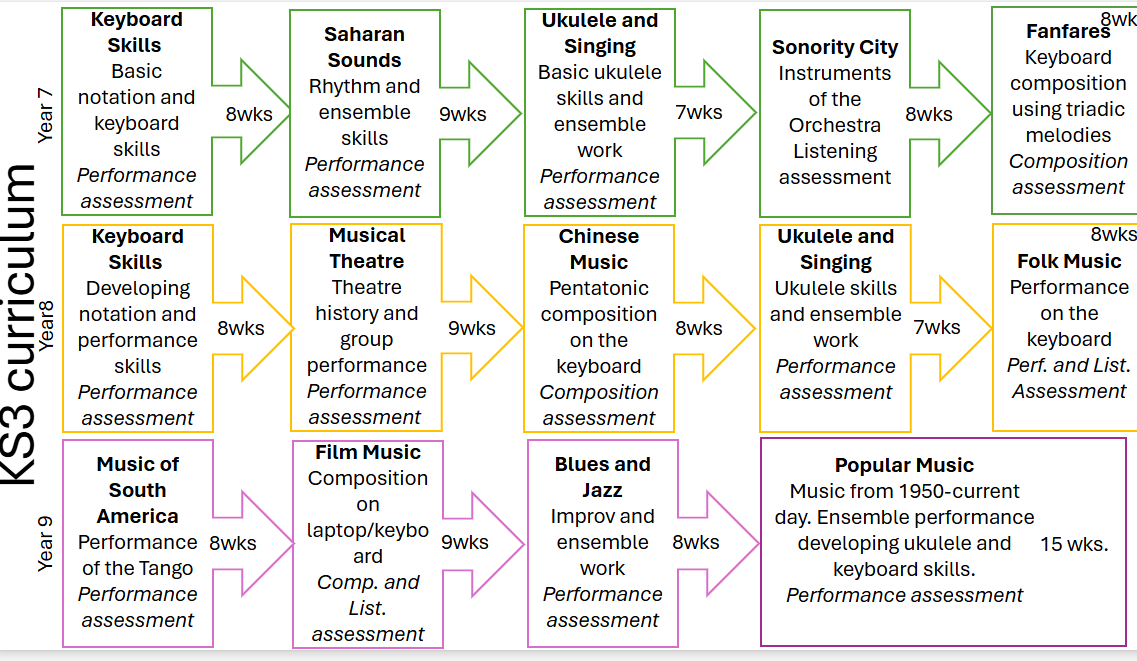
From Key Stage 3 through to Key Stage 5 we have designed our curriculum to develop the 3 main strands of music education which are:
Listening and Appraising music - Students will listen to a wide range of musical styles ranging from Western Classical Tradition through to Film Music, Musical Theatre and World Music styles. Students will learn basic music theory, including how to read notation including pitch and rhythm and will focus their listening on the musical elements, developing their musical vocabulary in order for them to discuss what they can hear with confidence.
Composing - Students will begin their composing journeys by learning how to compose a melody within a given structure. As their KS3 music lessons continue students will be given the opportunity to add harmony to a melody and write in more complex structures for a range of instruments. They will be given the opportunity to compose music using music software to realize their compositions.
Performing - At KS3 students will have the opportunity to learn basic keyboard skills, Ukulele skills and develop their vocal and percussion skills. Students will be given the opportunity to perform in front of their peers regularly to encourage collaborative musicianship and also to develop their confidence which will benefit students in many areas in the future. Students will have the opportunity to join the extra-curricular groups on offer throughout the school week. We also have a team of peripatetic teachers who offer 1:1 instrumental instruction.
Music is an optional subject for students. Those who choose to study Music at GCSE are expected to play an instrument and contribute to the wider music community in the school. In class, students will develop skills learnt at KS3 and will hone their musical appreciation, learning about a wide range of styles, under the following headings:
Area of Study 1: Musical forms and Devices
Area of Study 2: Music for Ensemble
Area of Study 3: Music for Film
Area of Study 4: Popular Music and Fusions
Students will also complete two compositions and prepare performances as part of the NEA coursework.
Term 1: Listening and appraising: AoS 1, building on music theory knowledge and exploring the musical elements. Beginning work on the prepared extract: Bach’s Badinerie.
Composing: Looking at basic composition skills, starting with short melodies and adding in harmonic patterns.
Performing: Solo and ensemble performances- developing instrumental skills on students’ chosen instruments.
Term 2: Listening and appraising: Continued study of Bach’s Badinerie. AoS 2: Music for Ensemble. Developing recognition of key features of different genres. Developing listening skills.
Composing: Developing basic composition skills, composing to a specific style.
Performing: Solo and ensemble performances- developing instrumental skills on students’ chosen instruments.
Term 3: Listening and appraising: AoS4: Popular music. The development of popular music from 1960’s onwards. Prepared extract 2: Toto’s Africa.
Composing: Blues composition
Performing: Developing Ensemble skills
Term 1:Listening and appraising: AoS 3: Music for Film. Revisiting AoS1 and the prepared extract: Bach’s Badinerie.
Composing: Begin final composition work- 1 x brief composition and refining ideas from year 10 mini composition tasks.
Performing: Working on final chosen pieces, ready to record at the start of term 2.
Term 2: Listening and appraising: Revisiting AoS 4 and the prepared extract Toto: Africa. Developing listening skills and confidence with key terms in an exam style.
Composing: Refining and completing compositions for February deadline.
Performing: Performance recordings to take place in the first two weeks of term.
Term 3: Listening and appraising: Final exam preparations.
Composing: Coursework has been submitted
Performing: Coursework has been submitted
More detail on the A level curriculum
Students who opt to take Music at A Level will continue their study of a range of musical styles and will be given the opportunity to
Term 1: Students will revisit and extend their music theory knowledge in preparation for beginning the analysis of their ‘Development of the Symphony’ set works. In the second part of this term, set work study will begin. Students will develop their composition skills in a range of different genres, beginning with 4 part writing.
Term 2: Continued study of the development of the symphony. Building exam, listening and writing skills. Students will continue to develop their composition skills and will develop their performance skills, beginning to think about their repertoire for their year 13 performance.
Term 3: Students will begin their studies in the optional set works. Students will continue to work on their composition and performance skills which they will take in to year 13.
Updated April 2026